The FDA holds various meetings to facilitate collaboration among sponsors, health care professionals, and other key stakeholders involved in the drug development and regulatory processes [2]. With a shared public health goal of providing safe, effective, and high-quality drugs to the public as early as possible, engaging in meetings with the FDA at critical junctures in the drug development process expedites the evaluation process and minimizes time and resources spent. These formal FDA meetings serve as opportunities to address questions and issues, to receive valuable scientific and regulatory advice, and ultimately to enhance the efficiency and effectiveness of the development program [1,2].
While the pertinent meetings for early investigations will be focused on FDA feedback from a Pre-IND Meeting (Type B Meeting in the list below) and potentially INTERACT meeting, the playbook provides, for context, the types of meetings that are available to the Sponsor as a program advances throughout development.
There are six types of formal meetings under the Prescription Drug User Fee Act (PDUFA) that occur between the FDA and the requesters, as shown in the figure below.
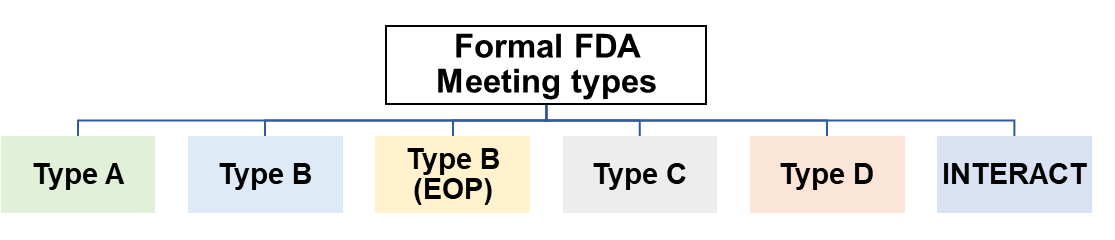
Now that you know what the different formal FDA meetings are, let’s proceed and briefly discuss each of the different meeting types [1-3].
Type A
Before submitting a Type A meeting request, consider contacting the review division or office to discuss the appropriateness
Type A meetings are held for currently stalled product development programs that are either looking to proceed or address an important safety issue. Some examples of Type A meeting types, as included in the FDA guidance, are:
Dispute resolution meetings as described in the Code of Federal Regulations (CFR) (21 CFR 10.74, 312.48, and 314.103) and in the guidance document
Meetings to discuss clinical holds where:
The requester can seek input on how to address the hold, or
The FDA and requester have agreed that the development is stalled, and a new path forward is needed
Special protocol assessment meetings after receipt of FDA Nonagreement Special Protocol Assessment letter in response to the protocols submitted under the special protocol assessment procedures
Post-action meetings requested within 3 months by the sponsor after an FDA regulatory action other than an approval
Meetings requested within 30 days of FDA issuance of a refuse-to-file letter. In order to file an application over protest, applicants must avail themselves for this meeting (21 CFR 88 314.101(a)(3))
Type B
Examples of Type B meetings as included in the FDA guidance are:
Pre-investigational new drug application (Pre-IND) meetings
Pre-emergency use authorization meetings
Pre-new drug application (pre-NDA) / Pre-biologics license application (pre-BLA) meetings
Post-action meetings requested by the sponsor 3 months or more after an FDA regulatory action other than an approval
Meetings regarding risk evaluation and mitigation strategies (REMS) or post-marketing requirements that occur outside the context of the review of a marketing application
Meetings held to discuss the overall development program for products granted break through designation status. A follow-up meeting can be considered either Type A or B, depending on which criteria it meets
Type B (EOP)
Examples of Type B End of Phase (EOP) meetings, as included in the FDA guidance, are:
Certain End of Phase 1 meetings for products in consideration for marketing approval under 21 CFR part 312 subpart E, or 21 CFR part 314 subpart H, or similar products)
End of Phase 2 / Pre-phase 3 meetings
Type C
Type C meetings are any other meeting than a Type A, Type B, Type B (EOP), Type D, or INTERACT meeting regarding the development and review of a product. An example of a Type C meeting, as included in the FDA guidance, is:
A meeting to facilitate early consultations on novel use of biomarkers as surrogate endpoints as the primary basis for product approval in the proposed context of use.
Type D
Type D meetings are focused on a narrow set of issues (should be limited to no more than two focused topics) and should not require input from more than 3 disciplines or Divisions. Some examples of a Type D meeting are:
A follow-up question that raises a new issue after a formal meeting (i.e., more than just a clarifying question about an FDA response from a prior meeting)
A narrow issue on which the sponsor is seeking Agency input with only a few associated questions
A general question about an innovative development approach that does not require extensive, detailed advice
INTERACT
INitial Targeted Engagement for Regulatory Advice on CBER producTs or INTERACT meetings are for novel questions and unique challenges in early development (i.e., prior to filing of an IND) intended to facilitate IND-enabling efforts where the sponsor is facing a novel, challenging issue that might otherwise delay progress of the product towards entry into the clinic in the absence of this early FDA input. The sponsor must have selected a specific investigational product or a product-derivation strategy to evaluate in a clinical study before requesting an INTERACT meeting. These meetings are intended to provide FDA input on issues that a sponsor needs to address early in a development program prior to a Pre-IND meeting. Some examples of INTERACT meeting questions include:
Novel questions for all CBER products (i.e., questions where there is no existing guidance or other information in writing the company could reference from the FDA)
Choice of appropriate pre-clinical models or necessary toxicology studies for novel drug platforms or drug candidates
CMC issues or testing strategies aimed to demonstrate product safety, adequate to support first-in-human study
Overall advice related to the design of proof-of-concept or other pilot safety / biodistribution studies necessary to support administration of an investigational product in a first-in-human clinical trial
General recommendations regarding a future first-in-human trial in a target clinical population where the population is novel and there is no prior precedent or guidance
Recommendations on approach for further development of an early-stage product with limited CMC, pharmacology/toxicology, and/or clinical data that were collected outside of a US IND
For more information, please refer to the INTERACT meeting section.