For this section of the IND, your goal is to describe the manufacturing processes, controls, and analytical methods used for your investigational product. It is essential that you provide an end- to-end view of the entire workflow and quality controls involved.
Module 3 is an important part of the IND submission that needs to be prepared with detail and clarity in order to demonstrate that you will have a product that meets safety standards required for the study in humans.
We will now dive into the details of what you need to cover in this section, starting with information on the drug substance. For a more detailed description of what to include in this section, see the Module 3.2S: Drug Substance section. [1]
Module 3.2S: Drug Substance
What is a Drug Substance?
A Drug Substance is the active ingredient that produces the intended pharmacological effect in the diagnosis, cure, mitigation, treatment, or prevention of a disease. This does not include intermediates used in the synthesis. For AAVs, the plasmid is often considered the drug substance.
In this section, you will provide the FDA with detailed information on the composition, quality, and manufacturing process of the drug substance. This will give the FDA assurance that the drug substance is manufactured and tested for purity and potency for use in clinical trials.
It is advisable that you cover the following:
Physical, chemical, and biological characteristics
Name and address of manufacturer
General method of preparation (include a list of the reagents and solvents)
Acceptable limits and analytical methods to assure identity, strength, quality, purity
Stability information (appropriate to phase of investigation)
Sample outline for Module 3.2S
Consider the sample outline below for the specific contents to include.
General Information
Nomenclature
Structure
General properties
Manufacture
Manufacturer(s)
Description of Manufacturing Process and Process Controls
Control of Materials
Controls of Critical Steps and Intermediates
Process Validation and/or Evaluation
Manufacturing Process Development
Characterization
Elucidation of Structure and other Characteristics
Impurities
Control of Drug Substance
Specification
Analytical Procedures
Batch Analyses
Justification of Specification
Reference Standards or Materials
Container Closure Systems
Stability
Stability Summary and Conclusions
Stability Data
For the general method of preparation, the FDA suggests a detailed flow diagram to complement a written description of the preparation. See table below. [2]
|
|
|
| Rep/Cap plasmid Transfer plasmid Helper plasmid |
|
|
|
.png)
.png)
.png)
.png)
Additionally, more information may be needed for a comprehensive assessment of the safety of biotechnology-derived drugs or drugs extracted from human or animal sources. It is recommended that you provide the FDA with:
A brief description of the testing and analytical methods that were used to ensure the identity, strength, quality, and purity of your drug substance along with acceptable limits
A brief description of your stability studies and methods you may have used to monitor the stability of your drug substance during toxicology studies
Preliminary tabular data based on representative material may be submitted
Given that the list of tests and attributes can be quite extensive for an AAV gene therapy product, the BGTC is actively working on establishing a minimal set of Critical Quality Attributes (CQAs) that will be included in future iterations of the BGTC Regulatory Playbook. These CQAs are applicable to most AAV gene therapies and can be used as a guideline for what you can include in your IND submission. It is important to include certificates of analysis or compliance to show quality control acceptance.
Given process development is at an early stage, the FDA expects to see continued development and refinement of quality tests and specifications. These development plans should be discussed during Pre-IND interactions with the FDA.
Module 3.2P: Drug Product
What is a Drug Product?
This is a finished dosage form, for example tablet, capsule, or solution, that contains a drug substance, generally, but not necessarily, in association with one or more other ingredients. For AAV gene therapy products, this usually means the final infusion or injectable solution, containing the vector and excipients (if any), in any final delivery device.
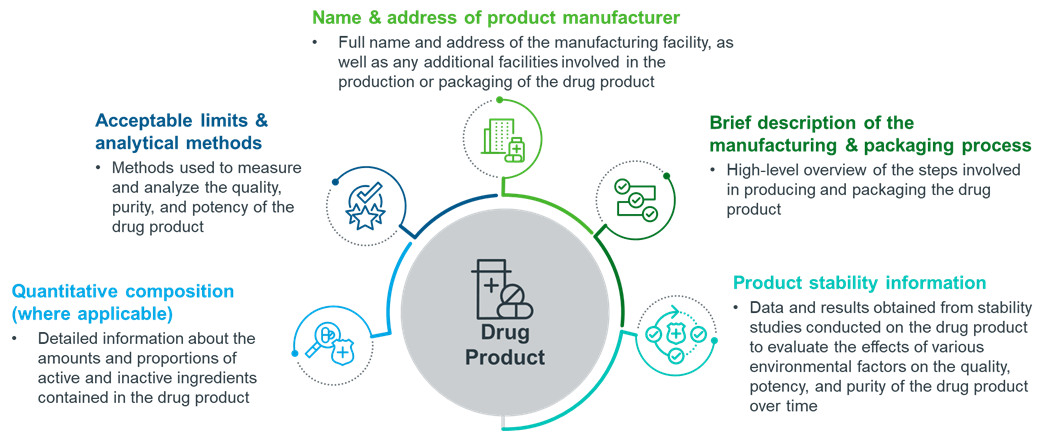
Similar to the drug substance sub-section, your aim here is to provide a detailed description of the drug product, including its composition, manufacturing process, and specifications. In this section, you should include information on the chemical structure and physical properties of your drug product, as well as its intended use and dosage form. You should also include a description of the formulation of the drug product, including the ingredients used and the manufacturing process, to provide assurance that the drug product is consistent in quality, purity, and strength. Additionally, you should include information on the stability of the drug product and its packaging, as well as any known or potential interactions with other drugs or substances. This information is critical for safety in human trials.
Similar to the drug substance section, the drug product section will contain lots of information. It is recommended that you break it down into different categories – see figure below for considerations.
You should provide a list of all components which are used in the manufacturing process. This includes, but is not limited to the following:
Cells
Cell banking systems
Viral banking systems
Reagents
Raw materials
Culture bags
Culture flasks
Chromatography matrices
Tubing
Container closure system
Your list should include reasonable alternatives for inactive compounds used in the manufacturing of the investigational drug product, including both components intended to appear in the drug product and those which may not appear, but which are used in the manufacturing process (also known as reagents).
A detailed flow diagram and a brief written description of the manufacturing process should be submitted, including sterilization process for sterile products. See below for a sample outline of the Drug Product section, showing the key topics to include in this section of the IND.
Drug product sample outline
|
|

You will most likely work with a contract development and manufacturing organization (CDMO) for manufacturing and testing of the drug substance and drug product. The CDMO may have a Drug Master File (DMF) in place which will facilitate preparation of your IND. In entering a partnership with your CDMO, a Quality Agreement will be established. This agreement will outline the roles and responsibilities between you and the CDMO. In most cases, the CDMO will manufacture, test, and release the drug substance and drug product batches per your specifications and will provide a signed Certificate of Analysis (COA) for each batch ensuring lot release testing criteria have been met. While this arrangement is typical and acceptable, as the drug developer, you are still ultimately responsible for ensuring your CDMO complies with all appropriate regulations and standard operating procedures, as outlined in your Quality Agreement. As for this section of the IND (Module 3.2P), be sure to include a copy of the COA for the clinical batch.
Given process development is at an early stage, the FDA expects to see continued development and refinement of quality tests and specifications. These development plans should be discussed during Pre-IND interactions with the FDA.
While AAV formulations are stable when frozen, stability studies are required to verify purity and potency in order to administer in human trials. Per the FDA’s feedback on the stability requirements, a sponsor may not be required to provide real-time stability data provided stability data from comparable products (other AAVs with similar manufacturing and packaging) is presented. For Phase 1 clinical batches, a sponsor may also propose a stability study that deviates from ICH guidelines and timepoints, provided the study design evaluates stability indicating attributes. You should present your modified stability study design in your Pre-IND meeting to obtain the Agency’s feedback, prior to submission in your IND.
Drug Master File (DMF)
Your CDMO may have a Drug Master File (DMF) submitted to the FDA. There are different types of DMFs which will contain different content depending on the type (see Drug Master File (DMF) Submission Resources (FDA.gov)). You must obtain approval from the DMF holder to refer to their DMF in your IND (this is commonly referred to as a Right of Reference Letter and is provided in Module 1.4.1 Letter of Authorization). If you rely on a DMF, you will need to ensure that it contains all the information necessary for the FDA to review your IND. The table below provides information on what sections are typically covered in a DMF. The Drug Product section is almost always covered in the IND, rather than a DMF.
Content | DMF (CDMO Responsibility) | IND (Sponsor Responsibility) |
|---|---|---|
3.2.S – Drug Substance | ||
3.2.S.1 General information 3.2.S.1.1 Nomenclature 3.2.S.1.2 Structure 3.2.S.1.3 General properties | X | |
3.2.S.2 Manufacture 3.2.S.2.1 Manufacturer(s) 3.2.S.2.2 Description of Manufacturing Process and Process Controls 3.2.S.2.3 Control of Materials 3.2.S.2.4 Controls of Critical Steps and Intermediates 3.2.S.2.5 Process Validation and/or Evaluation 3.2.S.2.6 Manufacturing Process Development | X | |
3.2.S.3 Characterization 3.2.S.3.1 Elucidation of Structure and other Characteristics 3.2.S.3.2 Impurities | X for those with * | X for all others |
3.2.S.4 Control of drug substance 3.2.S.4.1 Specification 3.2.S.4.2 Analytical Procedures* 3.2.S.4.3 Validation of Analytical Procedures 3.2.S.4.4 Batch Analyses 3.2.S.4.5 Justification of Specification | X for those with * | X for all others |
3.2.S.5 Reference standards or materials | X | |
3.2.S.6 Container closure systems | X | |
3.2.S.7 Stability 3.2.S.7.1 Stability Summary and Conclusions 3.2.S.7.2 Post Approval Stability Protocol and Stability Commitment 3.2.S.7.3 Stability Data | X | |
3.2.A - APPENDICES | ||
3.2.A.1 Facilities and Equipment [name, manufacturer] | X | |
3.2.A.2 Adventitious agents safety evaluation [name, dosage form, manufacturer] | X | |
3.2.A.3 Novel excipients | X | |
3.2.R – REGIONAL INFORMATION | ||
Drug Substance and Drug Product Batch Records | X |
Module 3.2A: Appendices (Facilities & Equipment, Adventitious Agents, Novel Excipients)
If you have supplemental information that may be helpful to the FDA in evaluating the safety, efficacy, and quality of your drug product, this is where you will want to include it. This information may include detailed descriptions of the analytical methods used to test the drug substance and drug product, additional data on stability testing, validation reports, and other relevant information. This section supplements the content of the main body of Module 3.
The appendices section of the IND Module 3 is not mandatory, but it is often included by sponsors to provide a more complete picture of the drug product and its manufacturing process. Including this additional information can help expedite the regulatory review process and increase the chances of approval for your IND application.
Module 3.2R: Regional Information
The goal of this section is to provide the FDA with details about the drug product manufacturing and control information for the specific region or country where you will be applying for approval of your AAV gene therapy product.
This section may include the following information:
Description of the manufacturing site(s) for the drug product, including details about the facilities, equipment, and personnel involved in the manufacturing process
Information on the quality control processes used during drug manufacturing, including specifications and testing procedures for raw materials, intermediates, and finished products
Details on the packaging and labeling of the drug product, including any specific requirements or regulations in the region
Information on the stability and storage conditions of the drug product during transportation and distribution
Any relevant regulatory requirements for the region, such as GMP (Good Manufacturing Practice) guidelines or other quality standards
Module 3.3: Literature
In this section, your goal is to include all the publications cited. Any referenced literature needs to include their full copies in this section (as separate pdf files – include links).