An Investigational New Drug application (IND) is a request from a pharmaceutical developer (also known as sponsor) to obtain authorization from the FDA to study their investigational product in humans. An IND is an exemption of the federal law that requires that any prescription drug transported across state borders must have a drug application approved by the FDA. Because most sponsors have manufacturing sites and clinical study sites across the United States, an IND is necessary to proceed with investigational trials of a new drug.
The FDA’s primary objectives in reviewing an IND are to enforce the safety and rights of subjects and assure that the quality of the scientific evaluation is adequate to permit an evaluation of the drug's effectiveness and safety. The FDA's review of Clinical Phase 2 and 3 data will also include an assessment of the scientific quality of the clinical investigations and the likelihood that the investigations will yield data capable of meeting statutory standards for marketing approval, so it is important to set yourself up for success from your IND submission.
What should I include in my IND?
The IND must contain information in three broad areas: [5]
In vitro and Animal Pharmacology and Toxicology Studies (Non-Clinical)
Chemistry, Manufacturing and Controls (CMC) Information
Clinical Protocols and Investigator Information
The information you must submit in an IND to optimize successful review depends upon factors such as the novelty of the drug, the extent to which it has been studied previously, the known or suspected risks, and the developmental phase of the drug.
An important part of the IND preparation process includes the general investigational plan and the protocols for specific human studies. Subsequent IND amendments containing new or revised protocols should build logically on previous submissions and should be supported by additional information, including the results of animal toxicology studies or other human studies, as appropriate. Annual Reports to the IND should focus on reporting the status of studies being conducted under the IND and update the general investigational plan for the coming year. The IND maintenance section of the playbook summarizes requirements for IND maintenance.
What format should I use for my IND submission?
Sponsors are required to follow the IND format set forth in CFR Title 21 Part 312.23 [2]. In the interest of fostering an efficient review of applications and harmonizing with global regulatory submissions, your IND should follow the eCTD format (electronic Common Technical Document – see Figure below) and should be submitted electronically through the FDA gateway.
The eCTD, which is divided into 5 sections, called modules, is the accepted standard format for submitting applications, amendments, supplements, and reports to the FDA’s Center for Drug Evaluation and Research (CDER) and Center for Biologics Evaluation and Research (CBER). The eCTD process also includes technical requirements for electronic submissions. Please refer to FDA’s eCTD Resource Page for more information.
The technical aspects of electronic submissions will not be covered in this playbook; however, the outline and format of the eCTD structure is reflected in the templates and section headers of the IND to comply with electronic submission specifications. Sponsors following the outline presented in this playbook will meet electronic submission format requirements.
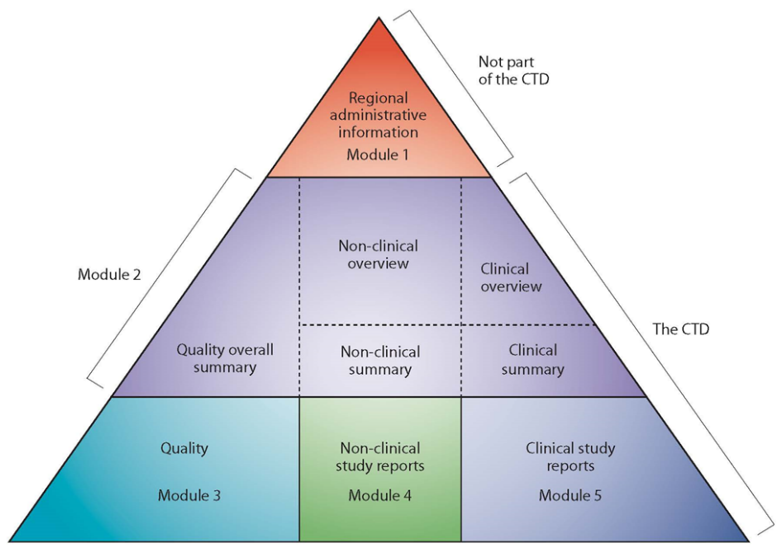
eCTD Modules
The CTD Triangle
The Common Technical Document is organized into five modules. Module 1 is region specific and modules 2, 3,4, and 5 are intended to be common for all regions
Before electronic submission of your IND, you must obtain an IND number through CBER. Similar to the Pre-IND process (see the Meeting Requests section), requests must be submitted via email to CBERRIMS@fda.hhs.gov and should contain the following information:
Name of Applicant, Applicant Address, Applicant Contact
Regulatory Contact (if different from Applicant contact)
Drug Name and Description
Indication
Review Division within CBER
Type of IND (commercial or research)
Once your IND is submitted, you will have to wait 30 calendar days before initiating any clinical trials. During this time, the FDA will review your IND for any safety concerns to ensure that research subjects will not be exposed to unreasonable risk.
Pro Tip
In some cases, the FDA may allow exceptions to electronic submissions by submitting a waiver. This may be appropriate, for example, for small non-profit organizations or research institutions. After you have requested and received the IND number, please send an email to esubprep@cber.fda.gov and formally request the waiver. Once your waiver request has been approved by the esubrep staff, you may submit the IND via DCC email at: cberdcc_emailsub@fda.hhs.gov.
Now that you know what an IND is and how it is submitted, we will get into the details of each specific module and what you will need to include in each section.